Reposted from Alex McLean.
I’m off to the RMA study day on “Embodied Research Methods in Music & Sound” in Liverpool on Tues 18th May. I’m looking forward to enjoying the very wide range of contributions, and hopefully getting some interesting responses to my ten-minute session, here’s the abstract:
Embodying algorithmic music
People have been making computer music with algorithms for long enough that these approaches are becoming ancestral technology. This brings us to an interesting point in the development of algorithmic music. Making music with code is still a comparatively fringe activity, but as a medium for human expression, is now one of the few use cases left for writing code entirely by hand. In this context, it is becoming easier to see what algorithmic music is, and how it relates to older ancestral traditions. The embodied research method I’d like to share is performing algorithmic music in the form of vocal patterns, without the use of the computer, and then importing knowledge back to the design of live coding systems. This work began with learning Carnatic rhythms, in particular konnakol [2], where groups of non-lexical syllables (solkattu) are vocalised, while clapping the tala. Musicians and dancers, through traditions around e.g. the mridangam drum and bharatanatyam dance, create rhythms through yati, korvai and teermana structures, applying pattern transformations to create complex rhythms from a combination of simple parts, without the use of notation.
Through learning these embodied algorithms, I have been able connect them with live coding [1], through collaboration with percussionists B C Manjunath and Matt Davies. This work has lead to innovations in live coding language design, applied to the existing Tidal and Strudel platforms as well as a new language that I am currently developing. Through a lecture-performance, I will share how exploring algorithmic music through both body and code opens up new potential, grounded in ancient tradition.
[1] McLean, Alex. ‘From Konnakol to Live Coding’. Proceedings of the 12th ACM SIGPLAN International Workshop on Functional Art, Music, Modelling, and Design (New York, NY, USA), FARM 2024, 2 September 2024, 36–41. https://doi.org/10.1145/3677996.3678290.
[2] Sankaran, Trichy S. The Art of Konnakkol (Solkattu): Spoken Rhythms of South Indian Music. Lalith Publishers, 2010.
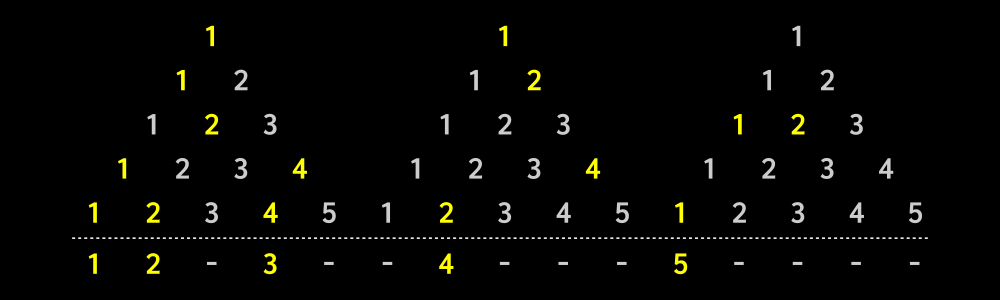
I tried something a bit similar at the recent “Natural Language as Heritage Code” workshop I ran with Wataru Uegaki, improvising some rhythms based on a ‘pyramid tala’ by reciting syllables while clapping. It’s strange performing carnatic-informed rhythms when it seems the experience of listeners is so different. For me I might be counting up from 1 to 5 in different ways, but it seems listeners experiences the trancey, shifting rhythms that result. I’ll be taking this further at the NIME conference in June, through an alt.NIME paper and separate performance with Matt Davies.
