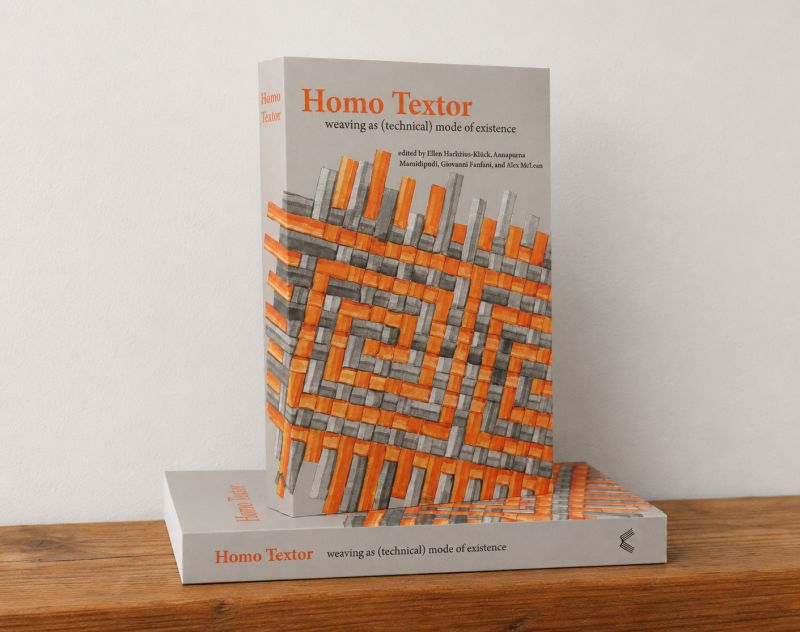
Homo Textor is published! It follows the PENELOPE project lead by Ellen-Harlizius Klück, which prefigured the Algorithmic Pattern project – fellow alpaca researcher Dave Griffiths and myself (Alex) were part of it for five years, applying live coding methods to weaving and braiding, and more importantly, vice-versa. It brings together diverse contributions considering handweaving (and other fibre arts) and its place in the history and philosophy of science and technology.
My own contribution is chapter 12 on the ‘live loom’ I made during the project, a rudimentary 16-thread warp-weighted loom which was more than enough to explore colour-and-weave effects via code. There will not be much here for experienced weavers, but it shares my experience with being surprised (and sometimes a little mind-blown) by the physical complexities arising from simple pattern transformations. I also interview Caroline Radcliffe in chapter 13 – we find a great deal of shared interests and perspectives on technology, perhaps surprising for a dialogue between clog dancer and computer programmer! Dave’s chapter is on his maypole dancing robots, which with their tablet-woven bodies follow live code in an attempt to create braids on the maypole, as a poetic meeting point between pattern, computation, reflections on human responsibility in an age of automation, and a very long view on the history of technology.
The chapters are all fascinating, and I recommend browsing all of them, starting with Ellen’s introductions.
The book is available in hard copy, as well as being open access for reading on the web and via PDF download.
- Introducing Homo Textor – Ellen Harlizius-Klück, Annapurna Mamidipudi, Giovanni Fanfani, Alex McLean
- The technical mode of existence of weaving: Introducing histomorphism – Ellen Harlizius-Klück
- Merge, weave, house, trap: First steps towards a reverse palaeoanthropology of identity concepts – Julian Rohrhuber
- Lost in lexicography: Kaîros as concept of order – Giovanni Fanfani
- Woven witness: Philomela, Procne and visualised narratives through textiles – Anthony Tuck and Cole Reilly with Cinzia Presti and Joseph Capozzi
- The textile expression gap – Lars Hallnä
- Modular patterns: A survey of the textile origin of neolithic design and its calculational implications – Kalliope Sarri
- Poikilia, geometry and living patterns in the Greek archaic and classical mind – Adeline Grand-Clément
- Epistemic, social, and material ordering through weaving threads – Annapurna Mamidipudi
- Comparative reflections on Andean weaving as science – Denise Y. Arnold
- String: Rewiring women and electronics – Ebru Kurbak
- Algorithmic patterns on the live loom – Alex McLean
- Embodying patterns of textile machinery: A dialogue – Caroline Radcliffe and Alex McLean
- Braiding and dancing: Embodied rhythm and the matter of pattern – Victoria Mitchell
- Untangling knowledge work by maypole weaving with a Penelopean robot swarm – David Griffiths

@blog Mira @danipupy @danipupy_
Remote Reply
Original Comment URL
Your Profile
Why do I need to enter my profile?
This site is part of the ⁂ open social web, a network of interconnected social platforms (like Mastodon, Pixelfed, Friendica, and others). Unlike centralized social media, your account lives on a platform of your choice, and you can interact with people across different platforms.
By entering your profile, we can send you to your account where you can complete this action.